

Turn your data into insight. Let's start with a 40-hour Tableau proof-of-concept for $2,500. Send your brief →

Ghostwrite is an AI-powered writing assistant focused on generating high-quality written content quickly, with a strong emphasis on copywriting, emails, and persuasive text. From the moment I landed on the site, it felt like the tool is positioned for marketers, founders, and anyone who needs conversion-focused writing without overthinking structure or tone.
Using it for the first time, what stood out is how streamlined the experience is compared to bulkier AI writing platforms. It does not try to overwhelm you with dozens of tools. Instead, it narrows the focus to practical writing outputs that you can actually use immediately.

The landing page immediately communicates speed and simplicity. There is no long explanation or layered storytelling. Instead, the messaging is direct and focused on writing faster with AI.
What stood out most is how little effort it takes to understand what the product does. Within a few seconds, it is obvious that this is a writing tool built for quick output rather than exploration or learning.
The design reinforces this idea. A dark-themed interface, strong typography, and generous spacing create a focused environment. There is no visual noise competing for attention, which aligns with the product’s core promise of speed.
You can explore Ghostwrite here.
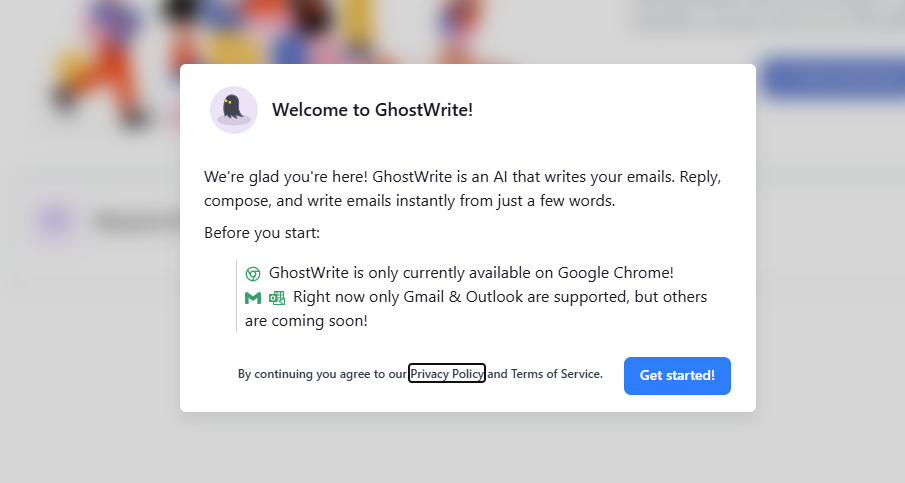
The signup process is minimal and frictionless. I used a standard email-based login and was inside the product within moments. There were no additional steps, verification loops, or setup questions.
Once inside, there is no structured onboarding flow. Instead of guiding me through tutorials, the interface immediately encourages me to start generating content. This creates a fast transition from signup to actual usage.
When I entered my first prompt, the system responded instantly with generated copy. That moment effectively replaces onboarding because the product demonstrates its value through output rather than explanation. The only drawback is that users without prior AI writing experience may need a few tries before understanding how to prompt effectively.
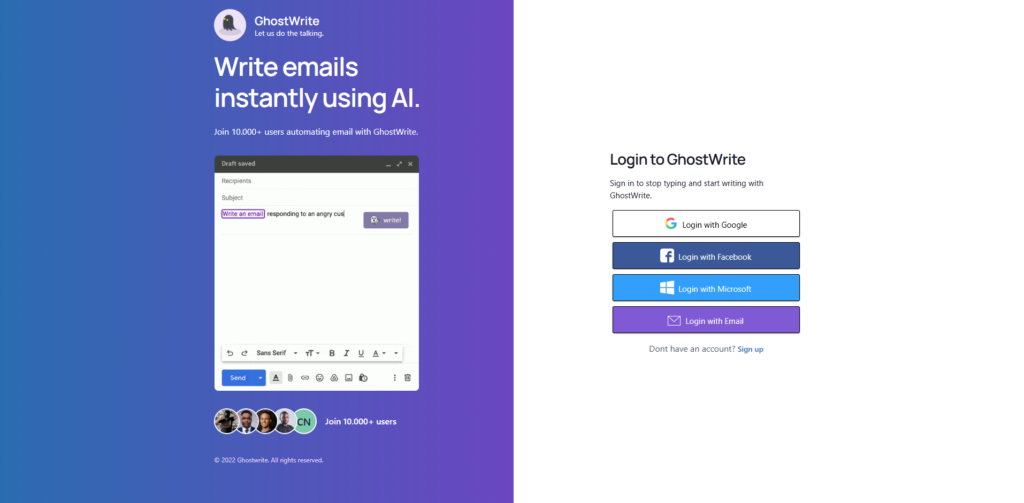

Inside the main interface, everything revolves around a single input-driven workflow. There is no traditional dashboard structure, no layered navigation, and no competing panels.
The central input field becomes the entire workspace. I type what I want to generate, select the type of content, and immediately receive output. The interaction loop is extremely tight.
As I continued using it, the lack of navigation actually became a strength. There are fewer decisions to make, which reduces cognitive load and keeps attention on output creation rather than interface exploration.
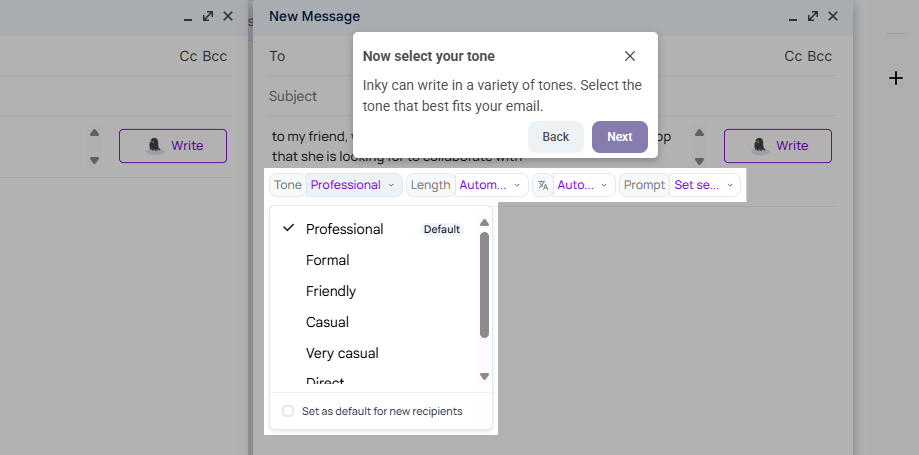
The first thing I tested was basic content generation. I started with email drafts and short marketing copy. The system responded quickly, producing structured outputs that were immediately usable without heavy editing.

When I moved into more marketing-focused outputs like landing page copy, the tone became noticeably more persuasive. The system clearly leans toward conversion-driven writing rather than neutral or informational content. This makes it particularly effective for sales and marketing use cases, but less suited for technical or long-form analytical writing.
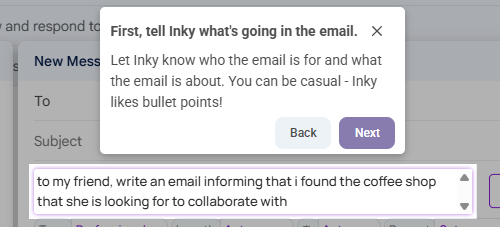
As I refined prompts, I noticed how quickly iteration works. I could adjust a few words and regenerate improved versions within seconds. This creates a fast feedback loop where writing becomes a process of refining rather than starting over.
The most consistent strength is iteration speed. The ability to rapidly generate, adjust, and regenerate content turns the tool into a real-time writing assistant rather than a static generator.
From a UX perspective, Ghostwrite is built around a single-loop interaction model. Everything revolves around prompt input and immediate output, with no secondary layers of navigation.
The interface relies heavily on whitespace and visual hierarchy to keep attention focused. There is a deliberate reduction of interface complexity, which eliminates distractions and decision fatigue.
For designers, this is a clear example of designing for output speed rather than feature discovery. For developers, it suggests a system optimized for rapid inference calls, lightweight rendering, and minimal frontend state complexity. The entire product prioritizes one core loop: input, generate, refine.
Ghostwrite likely uses a modern frontend framework such as React or Next.js to support its fast and responsive interface. The backend is likely powered by Node.js or serverless functions to handle prompt processing and generation requests.
AI generation is likely based on models similar to those from OpenAI or comparable large language model providers.
Infrastructure appears to be optimized for speed using cloud platforms such as Vercel or Amazon Web Services, enabling low-latency responses and quick iteration cycles.
Ghostwrite appears to be built by a small, product-focused team with a strong emphasis on simplicity and execution speed.
The direction suggests an indie or startup mindset, prioritizing fast iteration and practical output over feature-heavy expansion. The product philosophy is clear: reduce complexity and focus entirely on helping users generate usable copy quickly.
Pricing is not publicly displayed in a structured or transparent format. There is no clearly visible breakdown of tiers or subscription plans on the main interface.
However, during usage, there are strong signals of a freemium or usage-limited model. These include likely constraints on generation volume, potential feature restrictions, and possible prompts to upgrade after extended use.
Based on these signals, the monetization model appears to follow either a freemium structure or a simple subscription-based access system where unlimited usage is gated behind payment.
This lack of upfront pricing transparency suggests a product-led growth strategy. Instead of focusing on immediate conversion, Ghostwrite prioritizes getting users to experience value first. Once users integrate the tool into their workflow, monetization is introduced based on usage intensity rather than initial commitment.
Using Ghostwrite feels like working with a stripped-down writing engine designed purely for speed. There is no friction, no complexity, and no unnecessary structure between input and output.
It is best suited for users who need fast marketing and communication copy, especially emails, ads, and landing pages. The strongest aspect is how quickly it turns ideas into usable text with minimal effort.
At the same time, it is not designed for depth or long-form thinking. It prioritizes speed and simplicity over versatility.
Overall, Ghostwrite succeeds by doing one thing consistently well: reducing the time it takes to produce usable written content.

The Technology newsletter is a weekly digest of tech reviews, columns and headlines from Media Editor Mariebeth De Leus and RoadMap Founder Hoofar Pourzand.
Write to Hoofar at hpourzand@tryroadmap.com or Follow him here.